Passport fees 2026 India: Rs 5,000 Tatkaal vs Rs 2,500 normal, and what to pay first for a job abroad
Tips · 2026-11-14 · 9 min read
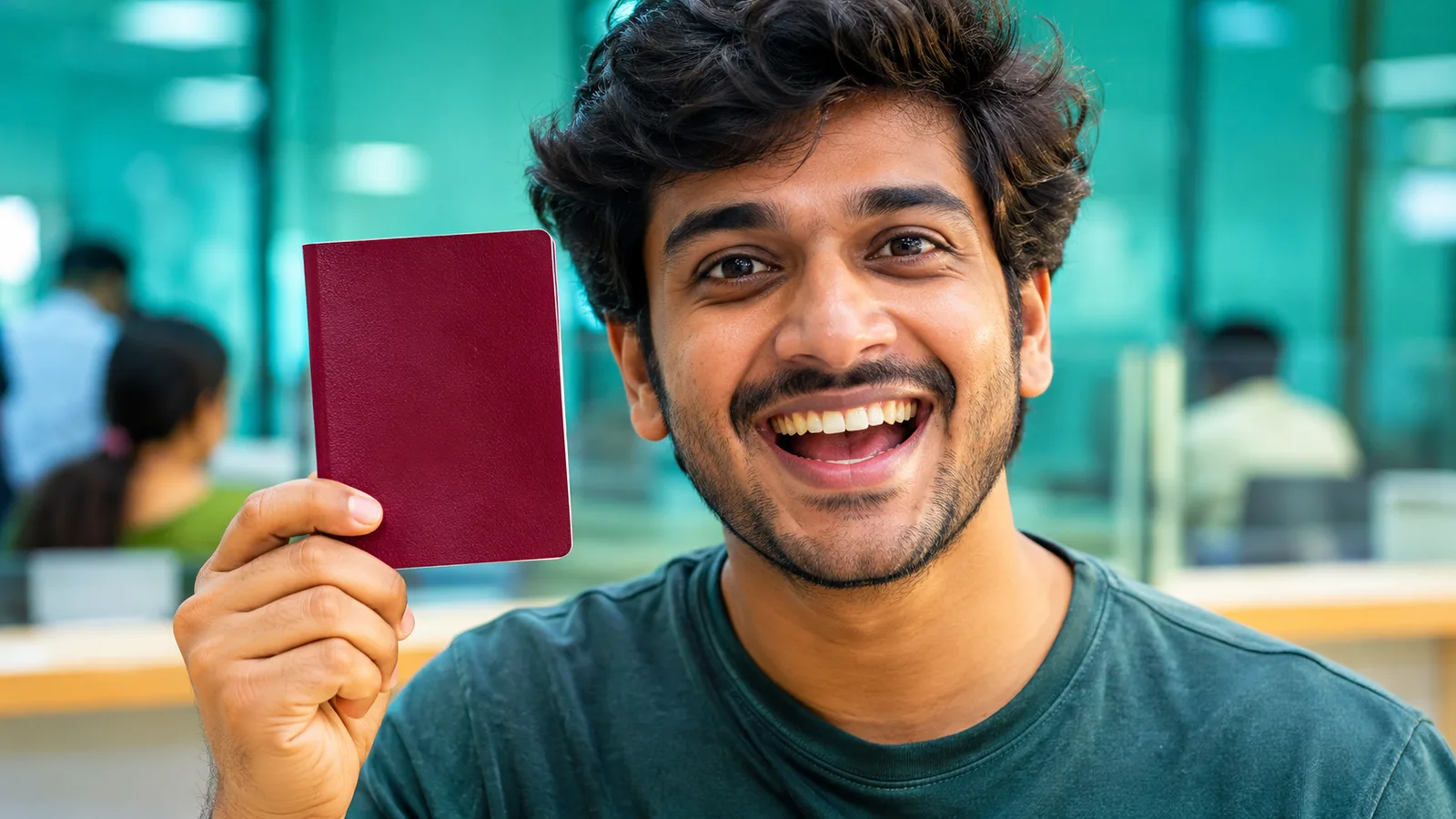
Passport fees 2026 in India changed on 1 July 2026: under Gazette Notification GSR 516(E) dated 25 June 2026, a fresh or reissued 36-page ordinary passport costs Rs. 2,500 in the normal category and Rs. 5,000 under Tatkaal. If you are planning work in Australia or New Zealand, the passport is only the first line of your document budget, because a Police Clearance Certificate (PCC) now costs Rs. 750 in India on top of it.
This guide sets out the new numbers, what the fee does not cover, and the passport detail that people moving abroad for work often misread: the ECR line, or the lack of one.
What the 1 July 2026 fee schedule says
The fee schedule comes from a Gazette Notification, and an Indian High Commission republishes it in a press release. You can read the government press release for the revised passport fees. Two lines matter for a job seeker applying from India.
| Item | Fee from 1 July 2026 | Where it applies |
|---|---|---|
| Fresh or reissued 36-page ordinary passport, normal | Rs. 2,500 | In India |
| Fresh or reissued 36-page ordinary passport, Tatkaal | Rs. 5,000 | In India |
| Police Clearance Certificate (PCC) | Rs. 750 | In India |
| Police Clearance Certificate (PCC) | $40 | Abroad |
If you need another booklet type or a different service, check the fee table on the official passport pages before you pay anything.
Normal or Tatkaal: what the extra Rs. 2,500 means for a work move
The gap between the two categories is Rs. 2,500, which is the full price of a normal passport. For most people applying for sponsored jobs, the real question is whether paying double buys anything they will use.
Ask it in the right order. A sponsored job in Australia or New Zealand starts with an employer's offer, and the visa application follows. You do not need a new passport to browse or apply, and if you already hold one with plenty of life left, a new one is not a job-search cost at all.
If your passport is close to expiry or full, treat the fee as a planned expense rather than an emergency. Planning ahead lets you choose the normal category and keep the extra Rs. 2,500 for documents that employers and visa officers do ask for, such as the PCC, medicals and certified copies of qualifications. Our guide to PCC and apostille costs in India shows how those smaller fees add up.
A simple document-budget sum
Here is the arithmetic for an applicant who needs both a passport and a PCC, using only the official fees above.
- Normal passport plus PCC in India: Rs. 2,500 + Rs. 750 = Rs. 3,250.
- Tatkaal passport plus PCC in India: Rs. 5,000 + Rs. 750 = Rs. 5,750.
These are government fees only. They leave out visa charges, medicals, skills assessments, English tests and travel to a Passport Seva Kendra. For the visa side, see Australian work visa fees in Indian rupees, and keep the passport and PCC figures on a separate line of your budget so that nothing is counted twice.
ECR and Non-ECR: what your passport shows
Passport Seva says that if you are in the ECR category, ECR is printed on your passport. If ECR is not printed, you are deemed to have Non-ECR status, and that status is not printed. So the absence of a print is the answer, which surprises people who expect a Non-ECR label.
The ECR rules matter for the destination. The Ministry of External Affairs (MEA) lists 19 ECR countries, such as Saudi Arabia, Kuwait, Qatar, the United Arab Emirates and Malaysia, and Australia and New Zealand are not among them. For jobs in those two countries, the Emigration Clearance described for the listed ECR countries does not apply. Our guide on when emigration clearance applies and when it does not gives the full picture, including why an older 17-country list still shows up on some pages.
Who gets Non-ECR status
Under Passport Seva's Non-ECR categories, everyone with a matriculation (pass) qualification or above, and everyone above the age of 50, is eligible for Non-ECR status with documentary proof. The list also includes holders of a two-year diploma from an institute recognised by NCVT or SCVT, and a three-year diploma or equivalent degree from recognised polytechnics. Professional degree holders such as engineers are on the list, as are income-tax payers with their spouses and dependent children. The Passport Seva instruction booklet gives the full list.
For a tradesperson or professional, that usually means asking for Non-ECR status when you apply, as long as you carry the proof. Bring the certificate that matches your category to the Passport Seva Kendra.
Order of steps when you need a new passport
- Check the expiry date and the blank pages on your current passport.
- Decide whether you need a new one now. If the passport is valid and has room, keep it and spend nothing.
- Collect the proof for your ECR or Non-ECR category, such as your education certificate.
- Apply through Passport Seva and pay the fee for your category: Rs. 2,500 normal or Rs. 5,000 Tatkaal.
- When the new passport arrives, check that the ECR print, or its absence, matches what your documents prove.
- Only then apply for the PCC, so that the certificate carries your current passport details.
The last step is a sensible habit rather than an official rule, so confirm the details with the passport office if your case is unusual. The MEA PCC page explains that a PCC is issued to Indian passport holders who have applied for residential status, employment or a long-term visa, or for immigration, and cannot be issued for persons going abroad on a tourist visa.
Passport, PCC and what New Zealand now accepts
If New Zealand is on your list, the source of the PCC matters as much as its price. From 1 December 2025, Immigration New Zealand accepts only a PCC issued by a Regional Passport Office of the Ministry of External Affairs from Indian national visa applicants who live in India. A certificate from a Deputy Commissioner, Superintendent of Police or local police station is no longer accepted. Our post on why a police station certificate no longer counts covers this, and the Immigration New Zealand notice is the primary source.
In practice this ties your PCC to your passport. You apply at a Passport Seva Kendra, and the country the certificate is issued for is stamped on the passport. It is issued the same day when the police verification report for your existing passport is clear; otherwise it follows only after police verification.
Where the passport sits in a real job application
For most listings, the sponsor cares about your skills first and the passport comes up at visa stage. A live listing such as a baker role in Mackay, Queensland asks you to read each requirement closely. MigrateJobs' About page tells candidates to check experience, qualifications, licences and English, then send a CV and trade certificates by email or WhatsApp from the job page. A tidy CV is a better use of your first week than rushing a Tatkaal passport, and Build AI CV can help you put one together.
Agents have their own limits too: our guide to what the Rs. 30,000 cap really covers explains the service-charge limit in an MEA advisory. MEA also tells emigrants to check a recruiting agent on the eMigrate portal. Nobody should charge you extra to handle a passport and call it a visa fee.
Common mistakes
- Paying Tatkaal by default. The extra Rs. 2,500 is only worth it if a real deadline requires it.
- Renewing a passport that is still valid. A job search does not require a new booklet by itself.
- Expecting a Non-ECR stamp. Non-ECR is not printed; a passport without ECR printed is deemed Non-ECR.
- Applying for the PCC before the passport is sorted. Get the passport details settled first.
- Paying an agent a "passport and visa package". The government fee for the passport is the figure above, so ask for a receipt and check the agent first.
- Using old fee tables. Pages that still show pre-July 2026 amounts are out of date.
Frequently asked questions
What is the passport fee in India in 2026?
From 1 July 2026, a fresh or reissued 36-page ordinary passport costs Rs. 2,500 in the normal category and Rs. 5,000 under Tatkaal, under Gazette Notification GSR 516(E) dated 25 June 2026. Check the official fee table for other booklet types.
How much is a police clearance certificate in 2026?
The PCC fee from 1 July 2026 is Rs. 750 in India and $40 abroad, under the same notification. The certificate is issued to Indian passport holders applying for employment, residence or long-term visas, and is not issued for tourist travel.
Do I need ECR clearance to take a job in Australia or New Zealand?
MEA's list of 19 ECR countries does not include Australia or New Zealand, so the Emigration Clearance it describes applies to employment in the listed ECR countries only. Check MEA's current overview before you travel, because lists have been updated before.
How can I tell whether my passport is ECR or Non-ECR?
If you are in the ECR category, ECR is printed on your passport. If it is not printed, you are deemed to have Non-ECR status, which is not printed anywhere in the booklet. Passport Seva's instruction booklet lists who qualifies.
Does matriculation make me Non-ECR?
Passport Seva's Non-ECR categories include everyone with an educational qualification of matriculation (pass) and above, with documentary proof. People above 50 are also eligible, as are holders of recognised diplomas and professional degrees. Carry the matching proof when you apply.
Key takeaways
- From 1 July 2026 a 36-page passport costs Rs. 2,500 normal or Rs. 5,000 Tatkaal, and a PCC costs Rs. 750 in India.
- A normal passport plus a PCC adds up to Rs. 3,250 in government fees; the Tatkaal route adds up to Rs. 5,750.
- Australia and New Zealand are not on MEA's list of 19 ECR countries, so ECR clearance does not apply to jobs there.
- No ECR print on your passport means Non-ECR, and matriculation and above qualifies with proof.
- New Zealand accepts only Regional Passport Office PCCs from Indian applicants living in India.
#passport fees 2026 india #tatkaal passport fee #passport renewal fee india #pcc fee 750 #non ecr passport #ecr passport australia #documents for australia job #new zealand jobs for indian professionals
 Cost of moving to Australia from India: the ₹30,000 agent cap and bills that are never yours
 Australia work visa with family from India: a family of four adds AUD6,025 to the bill
 Jobs in Australia for Indians: 673,352 are already there, but sponsors still set the rules